
GameStop is a PSA authorized dealer, not a grading company. You hand over your cards, GameStop packs them and ships to PSA via FedEx under their dealer account, PSA grades and slabs the cards, then ships them back to the store. You pick up your slabs, or pay extra to have them mailed. That's the whole operation. No magic, no mystery, just a middleman with retail locations.
For collectors who haven't submitted directly to PSA before, GameStop solves two friction points: you don't need a PSA account, and you don't have to figure out how to pack and ship cards to a grading company. But it also introduces trade-offs that most first-timer guides skip over, including a real insurance gap during FedEx transit that neither GameStop nor PSA covers.
How PSA Grading at GameStop Actually Works
GameStop became a PSA authorized drop-off location in 2024. The stores that participate offer the service at the counter near the trade-in area, the same place you'd bring used games. Staff don't grade your cards. They don't evaluate condition or give opinions on grade likelihood. Their job is to document what you hand over, pack it in Card Saver I holders, and ship the batch to PSA.
PSA receives the submission under GameStop's dealer account, grades each card individually, slabs them, and ships the order back to the store on a batch basis. Your cards go through the same PSA grading process as any other submission: same graders, same standards, same PSA certification label. The dealer channel doesn't get preferential treatment or a separate grading track.
Once slabs arrive back at the store, GameStop emails you or posts an update to your account. You can pick them up in-store, or pay an additional fee for home delivery. The whole chain, from drop-off to slab in hand, runs roughly 45 to 90 days depending on PSA's current backlog.
One distinction @Tony_Denaro on X flagged for first-timers: GameStop is a drop-off service. They send cards to PSA via FedEx. They don't grade anything. That distinction matters because it tells you where in the process your cards are and who you can contact if something goes wrong, which is GameStop customer support, not PSA.
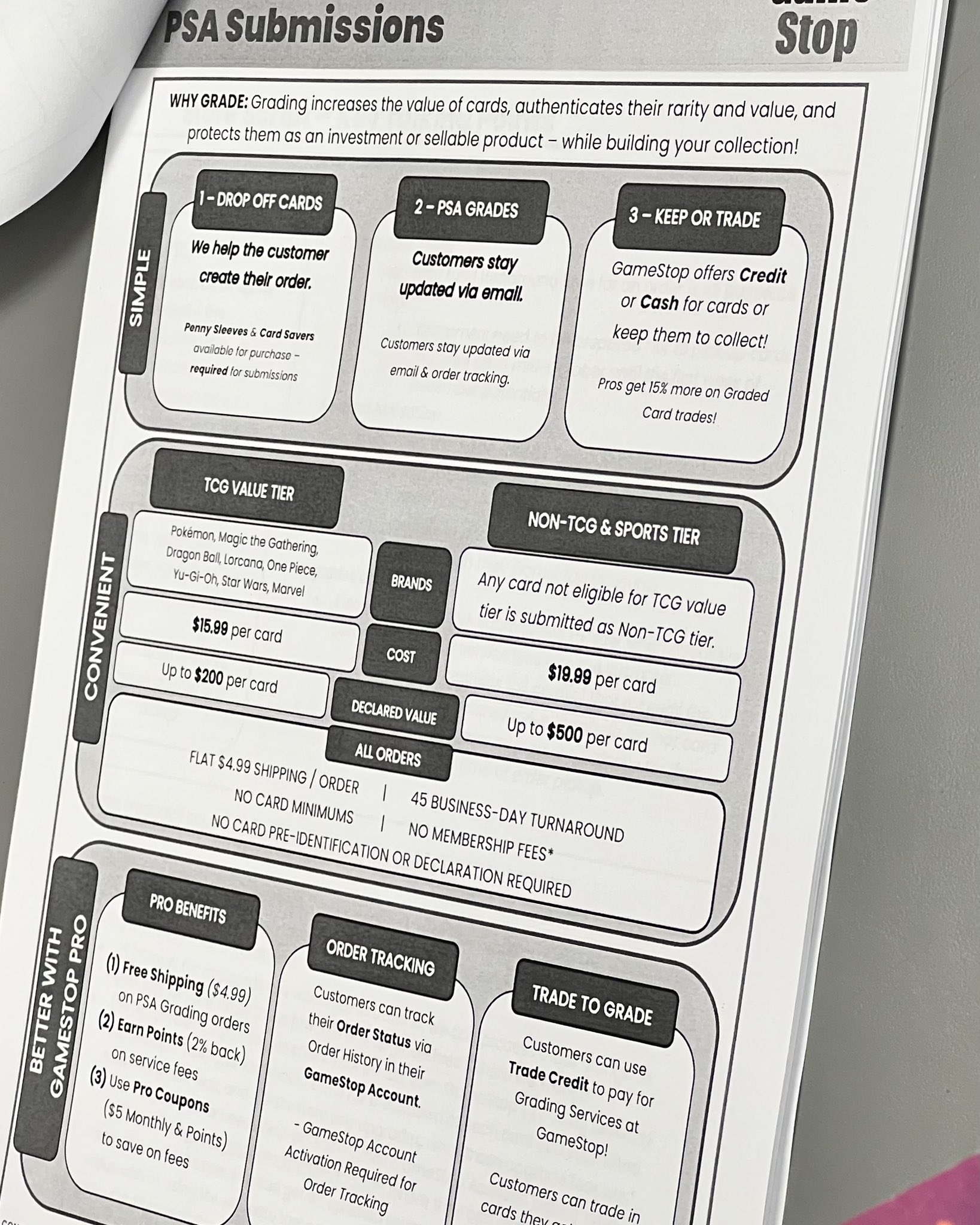
GameStop PSA Grading Costs: 2026 Pricing
The pricing is competitive for TCG cards. At $15.99 per card, GameStop undercuts PSA's direct rate for collectors without a Collectors Club membership by more than $17 per card. Even against PSA's $24.99 Value Bulk tier (which requires a $149/yr membership and a 20-card minimum), GameStop costs less per card.
The table below shows the current cost comparison as of April 2026.
| Submission Route | Cost Per TCG Card | Membership Required | Declared Value Cap | Shipping Fee |
|---|---|---|---|---|
| GameStop Drop-Off | $15.99 | No | $200 per card | $9.99 flat |
| PSA Direct — No Membership | $32.99 | No | Up to $499 | You arrange |
| PSA Direct — Value Bulk | $24.99 | Yes ($149/yr) | Up to $499 | You arrange |
| PSA Direct — Express | $149.00 | No | Up to $2,499 | You arrange |
| PSA Direct — Super Express | $299.00 | No | Up to $4,999 | You arrange |
Beyond the per-card rate, GameStop charges a flat $9.99 shipping fee per order, regardless of how many cards you submit. There's no minimum card count. Submitting a single card costs $15.99 plus $9.99, or $25.98 total. Submitting ten cards costs $159.90 plus $9.99.
TCG cards accepted include Pokemon, Magic: The Gathering, Lorcana, Yu-Gi-Oh, Dragon Ball Super, One Piece, and Star Wars Unlimited. Sports cards and non-TCG cards price at $19.99 per card with a declared value cap of $500.
You don't need a PSA membership. That's the clearest practical advantage for collectors who only grade a handful of cards per year. A $149 PSA Collectors Club membership pays for itself only if you submit enough cards at bulk rates to offset the fee. Collectors who grade fewer than six cards per year come out ahead with GameStop's flat rates.
Step-by-Step: Dropping Off Cards at GameStop
Not every GameStop participates. Use the store locator at gamestop.com and filter for card grading, or call your local store before driving over. Some locations have paused the service, and staff at non-participating stores won't know what to do with your cards.
The process takes 10 to 15 minutes at the counter for a typical submission of five to ten cards. Stores with high trade-in volume can have a wait, especially on weekends. Morning weekday visits tend to move faster.
Bring cards already in penny sleeves. GameStop staff will re-sleeve in Card Saver I holders before packing for shipment. Starting in penny sleeves protects condition during the time between drop-off and pack-out, which can vary based on when the store batches its next shipment to PSA.
For supplies, Ultra Pro Penny Sleeves affiliate work well for pre-sleeving submissions. Card Saver I holders come standard in the GameStop pack-out, so you don't need to bring them.
The Insurance Gap: What Happens If Your Cards Get Damaged
This is where GameStop's Terms and Conditions matter, and most guides in this space don't explain it clearly.
GameStop's grading terms state they are not responsible for cards damaged, lost, or stolen during transit. FedEx covers the package based on the declared value you set at drop-off, not the card's current market value and not the graded value the card might have reached. If you declare $150 for a card that would have graded PSA 10 and sold for $600, FedEx pays $150 if the package gets damaged. GameStop pays nothing. PSA pays nothing.
The table below maps who accepts risk at each stage of the submission chain.
| Stage | Who Handles Cards | Who Bears Risk | Coverage |
|---|---|---|---|
| Drop-off to store | Collector hands to GameStop staff | Collector | None after handoff |
| Store to PSA (outbound) | FedEx under GameStop dealer account | GameStop (but T&C waives liability) | FedEx declared value only |
| At PSA facility | PSA graders and handlers | PSA (limited) | PSA standard handling policy |
| PSA to store (return) | FedEx return shipment | Neither party guarantees | FedEx declared value only |
| Store to collector | GameStop staff to collector | Collector | None after pickup |
The most exposed stage is the outbound FedEx leg from GameStop to PSA. That leg travels under GameStop's dealer account. You don't control the shipping. You can't add your own insurance. The declared value you set at drop-off is your ceiling.
This gap is real. Collectors on r/psa and the Revillution.net forums have documented it. One thread on Revillution titled “Gamestop and PSA grading: DO NOT DO IT” detailed a complaint where cards were damaged in transit and neither GameStop nor FedEx covered the full market value. The original poster noted that local card shops offering consignment grading services provided better accountability and clearer liability terms.
For cards worth under $150 raw, the gap is tolerable. You can declare accurate value and FedEx coverage matches your exposure. For cards worth $300 or more, the risk calculus changes. Submitting a $400 card with a $200 declared value cap means you're self-insuring the top $200 if something goes wrong.
The practical rule: use GameStop for cards under $150 raw. For anything above that, the insurance gap argues for direct PSA submission where you control packaging, shipping carrier, and declared value.
Is GameStop PSA Grading Worth It Compared to Going Direct?
The answer depends on your card values, how many you submit, and whether you want trade-in credit. The decision table below covers the most common collector scenarios.
| Scenario | GameStop Wins | PSA Direct Wins |
|---|---|---|
| TCG card under $200 raw | Yes — cheaper, no membership needed | Only if you need Express tier |
| TCG card over $200 raw | No — declared value cap is a problem | Yes — declare accurate value |
| Sports card under $500 raw | Yes — $19.99 vs $32.99, no membership | Only if you want specific tier |
| Sports card over $500 raw | No — cap too low | Yes — declare full value |
| First-time submitter | Yes — GameStop handles packing | Workable but more steps |
| Need Express turnaround | No — one tier only | Yes — Express and Super Express available |
| Want trade-in credit | Yes — GameStop Pro bonus applies | Not applicable |
| High-value vintage card | No — transit insurance gap too risky | Yes — control your own insurance |
GameStop wins for first-timers grading lower-value TCG cards. The $15.99 rate, no membership requirement, and no-hassle packing make it the easiest entry point to PSA. If you have five modern Pokemon cards under $100 raw and want to see what they grade without managing a PSA account, GameStop is the right move.
PSA direct wins for high-value cards and specific service tiers. GameStop offers one grading tier through their service. PSA direct lets you choose Express ($149/card, 10 business days) or Super Express ($299/card, 5 business days) for cards you want back fast. If you're sitting on a card worth $500 that you want graded before a set anniversary or event, GameStop can't get you there.
The $200 declared value cap for TCG cards is the hard limit. If your card is worth $250 and grades PSA 10 at $900, GameStop's cap means your transit coverage maxes at $200. That's an accepted risk for some collectors. For others, it's a deal-breaker. Know which camp you're in before you drop off anything worth real money.
For a full breakdown of what PSA charges at every tier, see our guide on PSA grading cost per card. If you're undecided on whether grading makes financial sense at all, is PSA grading worth it runs the ROI math with real eBay sold data.
Trading In PSA-Graded Cards at GameStop
GameStop accepts PSA 8, PSA 9, and PSA 10 graded cards for trade-in. The maximum per transaction is $1,500 in cash or store credit. PSA 7 and below are not accepted.
GameStop Pro members get 15% extra on graded card trade-ins, paid in cash or store credit. That bonus stacks with the standard graded card value GameStop offers at the counter. If GameStop quotes $200 for a PSA 10 slab, a Pro member walks out with $230 in store credit.
This creates a loop some collectors use deliberately: grade at GameStop, pick up the slabs, trade the ones you don't want to keep back at GameStop for credit toward games, consoles, or more cards. The trade-in values GameStop offers are below secondary market prices on eBay and COMC, as you'd expect from any retail buyer. But for collectors who want fast liquidity without listing and waiting for an eBay sale, it's a usable option.
GameStop's trade-in system prices slabs based on their internal data. A PSA 10 of a card with an $800 eBay market value might get offered $150 to $250 at a GameStop counter. If you want market value for your slabs, eBay or COMC will get you closer. GameStop trade-in is a convenience play, not a value play.
Common Complaints and What Reddit Says
The complaints collectors report consistently about GameStop PSA grading fall into three categories.
Turnaround time. GameStop estimates approximately 45 days from drop-off to slab pickup. Collectors on r/psa and Elite Fourum report actual turnaround closer to 60 to 90 days. GameStop batches submissions weekly or biweekly, so cards you drop off on Monday may not ship to PSA for another 10 days. That transit time comes before PSA's own processing window. Neither GameStop nor PSA guarantees a deadline.
Staff handling. Some collectors report cards arriving at PSA improperly sleeved, or cards handled without gloves during the pack-out process. GameStop staff aren't trained card handlers. Results vary by location and the individual employee working the counter. Collectors on the Elite Fourum PSA at GameStop thread recommend watching the pack-out process and speaking up if staff handle cards by the face or edges.
No pre-screening. GameStop staff can't tell you whether a card is likely to grade PSA 9 or PSA 10. They won't evaluate condition and they're not allowed to give grade estimates. Collectors hoping to get a second opinion before submitting need to go elsewhere, to local card shops or collector Discord communities. Walk in knowing what you expect your cards to grade, or you're submitting blind.
The positive reports center on the process working exactly as described when staff are attentive. Several first-time submitters on r/PokemonTCG documented smooth drop-offs, accurate tracking, and slabs arriving in solid condition. The complaints are real, but they're not universal. Location quality and staff attention vary.
For collectors in areas without a quality local card shop offering grading services, GameStop is often the most accessible entry point to PSA. The PSA grading alternatives guide covers CGC and BGS if you want to compare outside PSA entirely.
GameStop solves the right problem for first-time submitters. You don't need a PSA account. You don't need to figure out how to pack and ship a card correctly. You walk in with penny-sleeved cards and walk out with a receipt. For five to 10 modern Pokemon cards under $100 raw, that friction reduction is worth the $15.99 rate.
The insurance gap is the thing GameStop doesn't explain at the counter. FedEx transit from GameStop to PSA runs under GameStop's dealer account. You can't add your own insurance on that leg. The declared value you set at drop-off is your ceiling if the package gets damaged or lost. For a $75 raw card, that ceiling is adequate. For a $300 raw card with a PSA 10 value of $900, you're self-insuring the gap between your declared value and what the card was actually worth.
Staff handling varies by location more than most service-based operations. GameStop employees aren't trained card handlers. Some stores have staff who've learned proper technique. Others haven't. Collectors who care about edge and corner condition on cards they think are PSA 10 candidates should watch the pack-out process and say something if staff touches a card face or handles it without gloves.
PullRate's position: use GameStop for cards under $150 raw where the insurance exposure is acceptable and the flat rate beats PSA's membership math. Use direct PSA submission for anything worth more than $200 where you need to control packaging, carrier, and declared value coverage. The $15.99 rate is only the right number if the insurance terms work for the card you're submitting.
“Did my first PSA submission through GameStop. Five cards, $15.99 each, $9.99 shipping. Super easy. Staff took 10 minutes at the counter. Slabs came back in 58 days. For first-timers who do not want to deal with setting up a PSA account, this is the easiest path.”
— r/PokemonTCG“The thing nobody told me: GameStop terms say they are not liable for cards damaged or lost during FedEx transit. I found this out the hard way. A $300 card went missing and FedEx paid out my declared value, which was $150. GameStop said sorry, nothing we can do.”
— r/psa“Watched the GameStop employee handle my cards at drop-off. He picked one up by the face with no gloves. I said something and he was not apologetic. Staff quality is all over the place. Watch the pack-out before you walk away.”
— r/PokeGrading“GameStop says 45 days. My last two submissions were 67 and 81 days. They batch and ship to PSA once a week or less. Those extra two weeks at the front add up. Plan for 60 to 90 days, not 45.”
— r/pokemontcg“I use GameStop specifically for cards I am fine grading for my personal collection. Under $100, no big deal if it comes back a 9. The $200 declared value cap means I do not submit anything I would be upset about losing. Keep the expensive stuff for direct PSA where you control the insurance.”
— r/sportscardsFrequently Asked Questions
How much does PSA grading at GameStop cost?
$15.99 per TCG card (Pokemon, MTG, Lorcana, Yu-Gi-Oh, Dragon Ball, One Piece, Star Wars) with a declared value cap of $200 per card. $19.99 per sports or other card with a declared value cap of $500. A flat $9.99 shipping fee applies to the order regardless of card count. No minimum cards, no PSA membership required.
Is GameStop PSA grading legit?
Yes. GameStop is an authorized PSA dealer. Cards are graded by PSA using the same process as any direct submission. The concern isn't legitimacy. It's the insurance gap during FedEx transit and the declared value caps. The grading itself is real PSA.
How long does PSA grading take through GameStop?
GameStop estimates approximately 45 days. Neither GameStop nor PSA guarantees a turnaround time. Add GameStop's batch shipping delay (cards may wait up to two weeks before leaving the store), plus transit each direction, plus PSA's processing window. Actual turnaround commonly runs 60 to 90 days based on collector reports.
Can GameStop grade expensive Pokemon cards?
GameStop caps declared value at $200 for TCG cards. For cards worth more than $200 raw, submitting directly to PSA is the better option. You can declare the accurate market value and select a shipping and insurance level that matches your exposure.
What happens if GameStop loses or damages my cards?
GameStop's Terms and Conditions state they're not liable for cards damaged, lost, or stolen during transit. FedEx shipping coverage is limited to the declared value you set at drop-off, not the card's market value or potential graded value. For high-value cards, this gap is a meaningful risk with no backstop.
Do you need a PSA membership to grade at GameStop?
No. That's one of GameStop's clearest advantages. No PSA membership required, no minimum cards. For collectors who don't submit enough cards to justify a $149/yr PSA Collectors Club membership, GameStop is the cheaper entry point to PSA grading.
Can you trade in PSA-graded cards at GameStop?
Yes. GameStop accepts PSA 8, 9, and 10 graded cards for trade-in, with a $1,500 maximum per transaction. GameStop Pro members receive an extra 15% on graded card trade-ins in cash or store credit. Trade-in values are below eBay market prices. This is a convenience option, not a way to maximize slab value.
Is GameStop the only retail entry point to PSA?
No longer. PSA grading kits are now sold at Best Buy for $99 (four submission credits included). Some collectors on X have noted the Best Buy kits as an alternative for those without a nearby participating GameStop. The GameStop route still has the advantage of no upfront kit cost and no minimum card count.