
One grade point separates a card worth $160 from one worth $1,100. Collectors on r/psa describe submitting cards they were certain were PSA 10s, only to get PSA 9s back because of centering they couldn't see with the naked eye. The difference between PSA 9 (Mint) and PSA 10 (Gem Mint) is measured in millimeters and magnification, but its financial impact is measured in multiples. This guide gives you the official standards side by side, real eBay sold prices for both grades, and a decision framework for knowing when PSA 9 is worth grading and when it isn't.
PSA 9 vs PSA 10: The Official Standards Side by Side
PSA publishes its grading standards at psacard.com/gradingstandards, but the clinical language buries the key differences. The table below translates the official specs into the attributes graders evaluate.
| Attribute | PSA 10 (Gem Mint) | PSA 9 (Mint) |
|---|---|---|
| Centering (front) | 55/45 or better | 60/40 or better |
| Centering (back) | 75/25 or better | 90/10 or better |
| Corners | Four perfectly sharp corners | One corner with slight wear allowed |
| Edges | Perfectly clean edges | Slight roughness on one edge allowed |
| Surface | Full original gloss, no staining | One minor flaw (wax stain, minor print defect) allowed |
| Print defects | None visible at normal viewing distance | One minor printing imperfection allowed |
| Focus | Sharp focus throughout | Sharp focus throughout |
The centering spec is where most PSA 9s are born. PSA 10 requires centering no worse than 55/45 on the front, meaning the card's image can be shifted at most 10 percentage points toward one side. PSA 9 allows 60/40, an additional 5 points of tolerance. On a standard Pokemon card, that translates to roughly 1mm of border difference being the line between getting a 9 and a 10. The back centering is more forgiving for PSA 10 (75/25), but collectors frequently overlook backs and lose the 10 there.
The surface and corner specs matter as much as centering in practice. PSA 10 demands four perfectly sharp corners under magnification. PSA 9 allows one corner with slight wear. A single corner tap from sliding a card across a table, something that leaves no visible damage to the naked eye, often shows up under a 10x jeweler's loupe as fraying that puts the card at PSA 9. Collectors on Blowout Forums describe this as the most frustrating part of the standard: microscopic corner damage that costs thousands of dollars on high-value cards.
PSA 10 also prohibits staining entirely. PSA 9 allows one minor flaw, which can be a slight wax stain, a minor printing imperfection, or slight roughness on one edge. Both grades allow for printing defects if PSA's graders determine the defect doesn't impair the overall appeal of the card.
The Price Gap: What PSA 9 and PSA 10 Sell For
The sold data below pulls eBay completed listings for four cards across different card categories. These are the actual prices collectors paid for PSA 9 and PSA 10 copies in early 2026.
| Card | PSA 9 (eBay sold) | PSA 10 (eBay sold) | Multiplier | Raw price |
|---|---|---|---|---|
| Charizard ex 199 (Pokemon 151) | $85 | $420 | 4.9x | $55 |
| Base Set Charizard (Shadowless) | $1,850 | $12,500 | 6.8x | $650 |
| Umbreon ex SAR (Prismatic Evolutions) | $160 | $1,100 | 6.9x | $220 |
| Cooper Flagg 2025 Topps Chrome Rookie Auto | $280 | $1,400 | 5.0x | $180 |
The multipliers tell the story. Across all four cards, PSA 10 commands 4.9x to 6.9x more than PSA 9. For the Umbreon ex SAR from Prismatic Evolutions, that gap means $940 separating the two grades. For the Base Set Charizard, the gap exceeds $10,000.
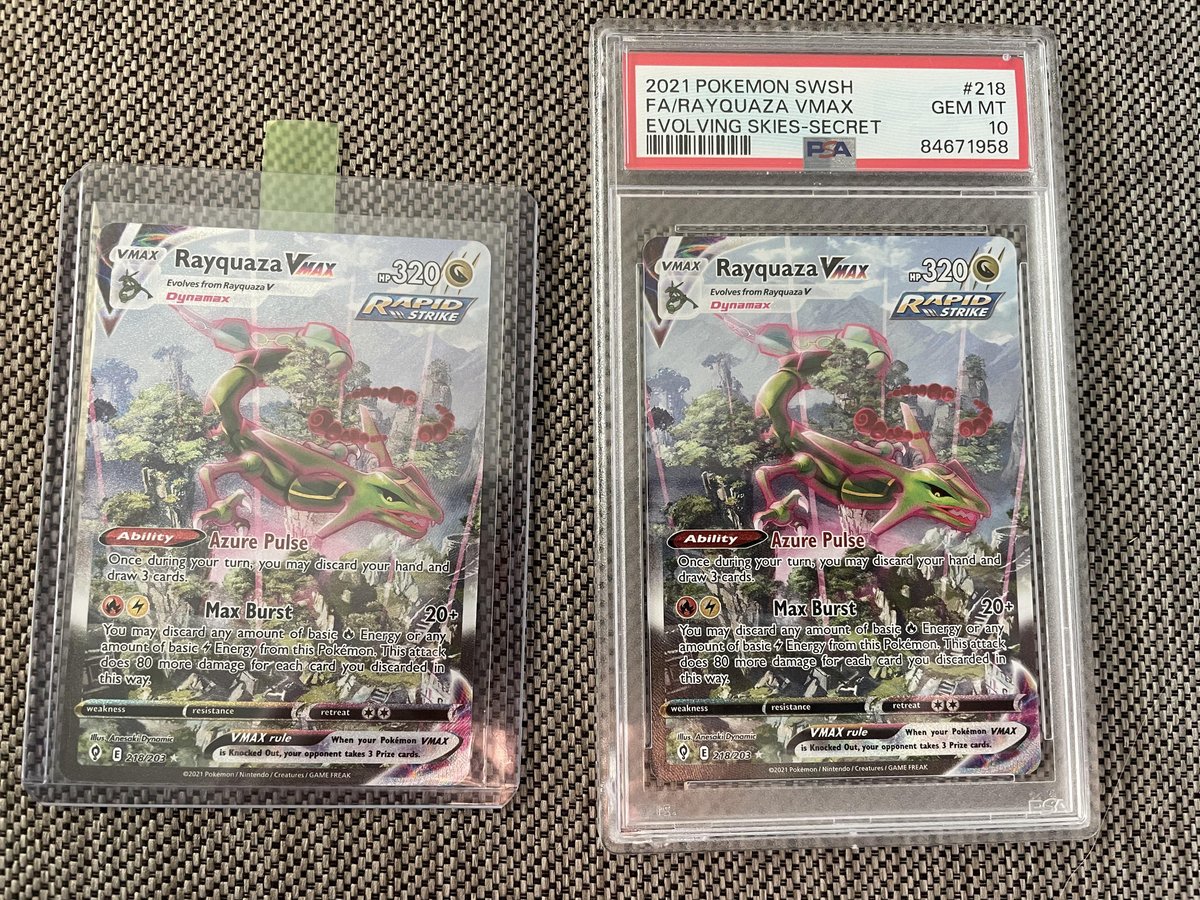
Notice the raw price column for Umbreon ex SAR: raw copies sell for around $220, while PSA 9 sells for $160. PSA 9 on that card destroys value. A collector who submits an Umbreon ex SAR, pays $40 to $45 in total grading costs, and gets a PSA 9 back has lost roughly $100 compared to keeping the card raw. The PSA 9 signals to buyers that the card had flaws, which makes buyers trust it less than an ungraded copy they can inspect themselves.
See PSA 10 Charizard ex 199 Sold Listings affiliate See PSA 9 Charizard ex 199 Sold Listings affiliateCooper Flagg shows a different pattern. PSA 9 sells for $280 on his Chrome Rookie Auto, which is $100 over raw. For sports rookies of named players, PSA 9 still carries a premium because buyers value the authentication and tamper-evident case as much as the grade. The same isn't true for most modern Pokemon cards, where PSA 9 routinely sells at or below raw.
Modern Cards: Why PSA 10 Is All That Matters
For cards printed from 2015 onward, the PSA 9 premium over raw typically falls between 0% and 20%. On many modern sets, PSA 9 sells below raw because buyers interpret the grade as a signal: this card was reviewed under magnification and found to have flaws. A raw card leaves room for optimism. A PSA 9 confirms imperfection.
Collectors on r/pokemontcg describe the PSA 9 problem on modern cards plainly. One post from r/psa put it this way: buying a PSA 9 on a modern card feels like paying grading fees to confirm the card isn't perfect. For Prismatic Evolutions SARs and modern chase cards, PSA 9 destroys the investment case.
The math on modern cards only works at PSA 10:
- PSA 10 modern Pokemon typically sells for 3x to 10x raw
- PSA 9 modern Pokemon typically sells for 0x to 1.2x raw (at or below raw value)
- After $40 to $45 in grading and shipping costs, a PSA 9 result on a $50 card is a loss
Pop report data from PSA shows that many modern sets have PSA 10 rates below 30%. Collectors on r/PokeGrading report that Prismatic Evolutions centering runs off from the factory, with several popular SARs grading at 20% to 25% PSA 10 on pack-fresh submissions. That means 3 out of 4 cards come back as PSA 9 or lower on cards where PSA 9 costs money rather than making it.
For modern cards, the decision rule is binary: if you can't see a strong PSA 10 case after a thorough self-grade, don't submit. Grading modern cards for PSA 9 isn't just a bad investment, it can leave you with a slab worth less than the raw card you started with.
Vintage Cards: Why PSA 9 Can Be a Great Investment
Vintage cards follow entirely different economics. For cards printed before 2000, achieving PSA 9 is rare and carries authentication value that buyers pay for regardless of the grade.
Take the Base Set Charizard. Printed in 1999, the card has centering issues from the factory, wear from 25 years of handling, and a counterfeiting problem that makes buyers cautious about raw copies. A PSA 8 Base Set Charizard removes all uncertainty about authenticity and locks in a grade that tells the buyer exactly what they're getting. PSA 8 Shadowless Charizards sell for $800 or more. Raw copies with the same visible condition sell for $400 to $500, and buyers discount them further because they can't verify the card isn't a reprint.
The vintage grading math:
- PSA 10 vintage cards are lottery territory. Base Set Charizard PSA 10 Gem Mint copies are extremely scarce (low double-digit population) and sell for $12,500 or more
- PSA 8 to 9 vintage cards sell for 2x to 4x raw because authentication value carries the premium
- PSA 5 to 7 vintage cards still outperform raw because buyers trust the sealed slab
For vintage cards worth $75 or more raw, grading at any reasonable expected grade almost always produces positive ROI. The authentication alone, proving the card isn't a fake, justifies the $40 to $45 cost. Collectors on r/pokemontcg and Elite Fourum vintage threads consistently say the same thing: PSA 9 on a Base Set Charizard is still an incredible investment. The grade matters less than the slab.
PSA grading cost breakdown shows the total cost per card across service tiers. For vintage cards worth $200 or more raw, the Regular tier at $79.99 often makes sense to avoid bulk submission delays.
How to Tell If Your Card Could Be a PSA 10
Before you pay for a submission, spend five minutes with a bright light and a jeweler's loupe. The self-grading check below will tell you whether your card is a realistic PSA 10 candidate or a likely PSA 9. For modern cards, that distinction determines whether you should submit at all.

The tool cost is minimal: a Carson 60-100x LED loupe runs $11.99 and pays for itself on the first card you decide not to submit. Collectors who skip this step report the most frustration on r/psa, submitting 20 cards expecting PSA 10s and getting back a mix of PSA 9s and 8s that don't cover the grading fees.
If your card passes all four checks with nothing visible under magnification, submit with confidence. If one minor issue appears, expect PSA 9, and decide whether that grade makes financial sense for your card type before paying. You can check current graded values on PullRate to see what PSA 9 and PSA 10 copies of specific cards sell for.
Population Data: When PSA 10 Is Worth More or Less
Not all PSA 10s carry the same value. A PSA 10 on a card with 3,000 existing PSA 10 copies sells for a fraction of what a PSA 10 fetches on a card with 15 copies.
PSA's Population Report at psacard.com/pop shows the number of copies graded at each level for any card in their database. Before submitting or buying a PSA 10, check the pop report. A pop-500 PSA 10 on a modern set tells you that 500 other collectors also pulled a perfect copy. Population growth on modern sets puts downward pressure on PSA 10 prices every year.
The counterintuitive case: a PSA 9 with a low population (pop 8) on a vintage card can sell for more than a PSA 10 with a high population (pop 400) on a modern card. Scarcity beats grade in those situations. Collectors on r/pokemontcg and Collectors Universe Forums point to low-pop PSA 9 vintage cards as sleeper investments, cards that are rare in any graded form and therefore worth more than their grade suggests.
For modern sets with pop 200+ at PSA 10, the grade premium shrinks every quarter as more submissions come back. Prismatic Evolutions PSA 10s sold for 10x raw in early 2025. By mid-2025 they sold for 5x raw as population grew. By late 2025, 4x to 6x raw. Pop growth matters as much as grade for investment decisions.
Should You Submit If You Think It's a 9?
The decision comes down to card type and raw value. Use this table before paying for any submission.
| Card type | Raw value | Grade for PSA 9? | Grade for PSA 10? |
|---|---|---|---|
| Modern Pokemon (post-2015) | Under $50 | No | No |
| Modern Pokemon (post-2015) | $50 to $200 | No | Yes, if centering passes |
| Modern Pokemon (post-2015) | Over $200 | No | Yes, pre-screen carefully |
| Vintage Pokemon (pre-2000) | Under $75 | No | Only if near-flawless |
| Vintage Pokemon (pre-2000) | $75 to $300 | Yes | Yes if corners are sharp |
| Vintage Pokemon (pre-2000) | Over $300 | Yes | Yes, always worth grading |
| Sports rookie (named player) | Under $75 | No | Only if you see PSA 10 |
| Sports rookie (named player) | Over $75 | Sometimes | Yes, pre-screen first |
For modern cards, the rule is clean: if you don't see PSA 10, don't submit. The grading fee will cost you money on a PSA 9 result. If you're grading for your collection rather than resale, that changes the math, but you should go in knowing the slab won't add monetary value.
For vintage cards, the bar is lower. Any vintage card worth $75 or more raw has a grading case at PSA 8 or above. Authentication value carries the premium even at lower grades. If you own a Base Set card in visibly played condition (PSA 4 to 6 territory), grading still makes sense for cards worth $100+ raw because buyers trust slabs over raw copies for vintage.
For sports rookies with real name value, PSA 9 can generate a meaningful premium over raw. Cooper Flagg, a top NBA draft pick with Topps Chrome and Bowman products, still commands $100 over raw at PSA 9. Named player rookies with a collector market hold their PSA 9 premium better than anonymous modern cards.
PSA grading alternatives covers CGC and BGS as options when you want a grade under 10 on a modern card and still need the authentication value. CGC charges $15 per card without a membership requirement, which improves the math on cards where PSA 9 is the expected result.
Submit to CGC affiliateThe 1mm centering difference that separates PSA 9 from PSA 10 on a modern Pokemon card can mean $800 in sale price. That's the number collectors need to internalize before submitting anything. It's not a grading quirk or a bad break. It's the standard, applied consistently, at a threshold that requires a loupe to see accurately with the naked eye.
The PSA 9 problem on modern cards is specific and well-documented. Buyers interpret PSA 9 on a modern card as confirmation of flaws, not partial certification. A raw card leaves the buyer room to imagine it's a near-10. A PSA 9 closes that door. For Prismatic Evolutions SARs, Charizard ex SIRs, and most chase cards printed after 2020, PSA 9 frequently sells at or below raw. Grading fees plus a PSA 9 result equals a loss in most of those cases.
Vintage cards are the mirror image. A PSA 9 Base Set Charizard in 2026 is a strong asset because authentication adds value at any grade above PSA 7. Raw vintage cards carry counterfeiting risk that slabs eliminate. Buyers trust slabs and pay accordingly. Cards from the 1999 to 2004 print window are old enough that PSA 9 is genuinely rare, which adds scarcity premium on top of authentication value.
PullRate's position: if you can't see a strong PSA 10 case after a serious self-grade with a loupe and a bright light, don't submit modern cards. The cost of a PSA 9 result isn't just the grading fee. It's the grading fee plus the difference between PSA 9 and raw, which is often negative. For vintage cards the bar is lower. Almost any card worth $75 or more raw has a grading case at PSA 8 or above because authentication carries the premium regardless of grade.
“Sent in 12 cards I was certain were 10s. Got 9 back as PSA 9, 3 as PSA 10. The ones that came back 9 all had centering I could not see without a loupe. You need a jeweler loupe before you submit anything if you care about the grade.”
— r/PokeGrading“PSA 9 on a modern card does not mean the card is in mint condition. It means PSA looked at it under magnification and found something wrong. Buyers know that. That is why PSA 9 modern cards sell at or below raw. You are paying grading fees to confirm imperfection.”
— r/pokemontcg“Prismatic Evolutions centering has been a mess from the factory. I have seen people report 20 to 25% PSA 10 rates on pack-fresh SARs. If 3 out of 4 submissions come back as 9s on cards where PSA 9 sells below raw, the math is brutal.”
— r/PokemonTCG“People forget that a PSA 9 Base Set Charizard is still an incredible card. Authentication alone is worth grading fees on vintage. Nobody sells raw 1999 cards at full value anymore because fakes are everywhere. The slab solves that problem.”
— r/pokemontcg“Checked the pop report before buying a modern PSA 10 last week. Pop 847 PSA 10s and growing. That is why the premium drops every quarter. The pop report tells you more about where a card is heading than the current eBay sold price.”
— r/psagradingFrequently Asked Questions
What is the difference between a PSA 9 and a PSA 10?
PSA 10 (Gem Mint) requires centering within 55/45 on the front and 75/25 on the back, four perfectly sharp corners under magnification, no staining, and full original gloss. PSA 9 (Mint) allows 60/40 centering on the front and 90/10 on the back, plus one minor flaw such as a slight wax stain, a minor printing imperfection, or a slightly rough edge. Both grades demand sharp focus and full original gloss, with PSA 9 allowing one exception.
How much more is a PSA 10 worth than a PSA 9?
For modern Pokemon cards, PSA 10 typically sells for 3x to 10x more than PSA 9. For vintage cards, the gap runs 5x to 20x because achieving PSA 10 on older cards is extremely scarce. On cards like the Base Set Charizard, the difference between PSA 9 and PSA 10 is measured in thousands of dollars. Real eBay sold data for specific cards is the most reliable way to check current spreads.
Is PSA 9 worth grading?
For modern cards printed after 2015, PSA 9 often sells at or below raw value after grading fees. It's not worth grading modern cards for a PSA 9 result. For vintage cards worth $75 or more raw, PSA 9 can return 2x to 4x the raw price because authentication value drives the premium. For sports rookies of named players, PSA 9 can still carry a meaningful premium over raw. The calculation is completely different for modern versus vintage.
What centering does PSA 10 require?
PSA 10 requires centering no worse than 55/45 on the front and 75/25 on the back. PSA 9 allows up to 60/40 on the front and 90/10 on the back. Centering is the most common reason a card receives PSA 9 instead of PSA 10. You can check centering at home with a ruler measuring border widths on each side before deciding whether to submit.
Can a card with a printing defect get a PSA 10?
Yes, with conditions. PSA 10 allows for a slight printing imperfection if it doesn't impair the overall appeal of the card. PSA 9 explicitly allows one minor printing imperfection. Factory defects in centering or minor surface variations from the printing process can appear on PSA 10 cards. Grader judgment applies, and there's no guarantee a factory defect will be classified as acceptable versus as a flaw.
What does PSA 10 Gem Mint mean?
PSA Gem Mint 10 means a card is virtually perfect, with four sharp corners, sharp focus, full original gloss, no staining, and centering within 55/45 on the front. It's the highest standard grade PSA awards. PSA also offers PSA 10 Pristine and PSA 10 Perfect for exceptional examples submitted through premium services, but standard submissions are graded on the 1 to 10 scale where 10 Gem Mint is the ceiling.
How rare is a PSA 10?
Rarity depends on the specific card. Modern mass-produced sets often have hundreds or thousands of PSA 10 copies in the population report. Vintage cards from the 1990s may have fewer than 10 PSA 10 copies on record. Check the PSA Population Report at psacard.com/pop for any card's PSA 10 count before submitting or buying. High-pop PSA 10s on modern cards lose value as population grows, so checking pop before you buy matters as much as checking the sold price.